So, it's been a busy week-- Madrid's decision to ban waifish models from some high-level fashion shows has had an interesting effect. It was widely covered, and a few other countries have spoken out against the too-thin trend too. (It goes to show that you only need one voice to start something larger!)
ABC News had an article about India's growing health concerns as their nation picks up more and more Western trends, including ideas of beauty. CNN had two articles-- one about fashion shows and concerns in London, where there was no ban, and another about the health of models in general.
I wonder if this is the start of a body-positive "eat right, exercise and accept your body" trend, or if it's just a very small ripple in a very large pond?
Friday, September 22, 2006

Wednesday, September 13, 2006
P&G invites us to "Have a Happy Period."
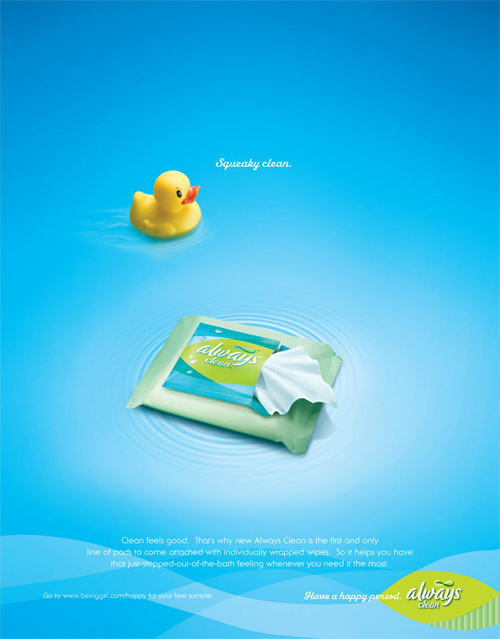
David over at ThirdWay Advertising Blog wrote an excellent review of some new Always print & media ads. They're all pretty decent, until we get to the tagline: "Have a Happy Period."
As he writes, there are a couple of ways to take that:
A) It's empowering! It's shedding the shame and fear and repulsion of the past and encouraging us to embrace our bodies!
B) Have you ever had a happy period? How dare P&G intrude upon a private, intimate, and sometimes very comfortable event.
Menstruation is definitely not a sign of women’s deficiencies, and it’s great that people (and companies) are trying to vigorously dispel that myth. At the same time, do they have to try this vigorously?
Thanks to some personal experiences, I'm sort of on the fence with this one. I like the idea of empowerment & positive affirmations, and esp. casting off the negative light of what is a natural process, but I don't want to be told that it should be happy, joyous, or otherwise. Thoughts?Another small issue: When you look at the ads and their emphasis on cleanliness, they might also make some women feel "dirtier" than they would otherwise during their period. Always means well, but I think certain women may receive mixed messages and feelings about the whole thing: Menstruation's natural, but here, take a wipe and clean up "that odor." Delivering a positive message but still selling a hygiene product is a bit of a balancing act in this case.
The ads were done by Leo Burnett, and to see more of them, go here. The tag line appears in the lower right of most of the print ads.
*In my opinion, it definitely crosses the line when Always's website has e-cards to send to gal pals "wishing them a happy period."

Monday, September 11, 2006
Great Works

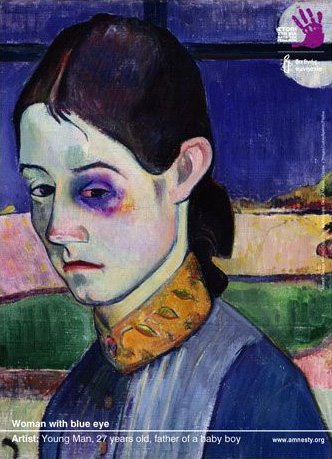
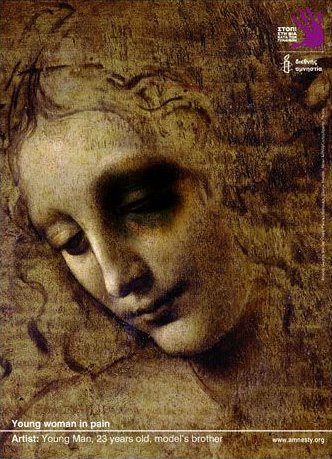
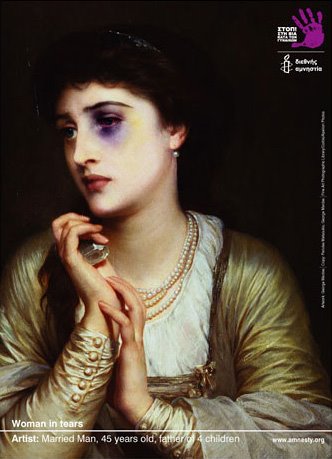
Further proof that public service messages don't have to be dry or over burdened with statistics. Using classic works of art to draw in our attention, the message is delivered in a subtle & intelligent manner. The selection of work used highlights that abuse can happen everywhere- your abuser doesn't care whether you're poor or rich, old or young, impressionist or baroque. It's a universal problem affecting everyone.
These were entrants into a competition from Amnesty International Greece; credit goes to Houtlust for the scoop!
Friday, September 08, 2006
One Man Fight
For one of the best PSA's I've seen about domestic violence, go to One Man Fight. And then spread the word.
(Found it on Houtlust today.)
(Found it on Houtlust today.)
Thursday, September 07, 2006
Radio Donna's Dance Spray
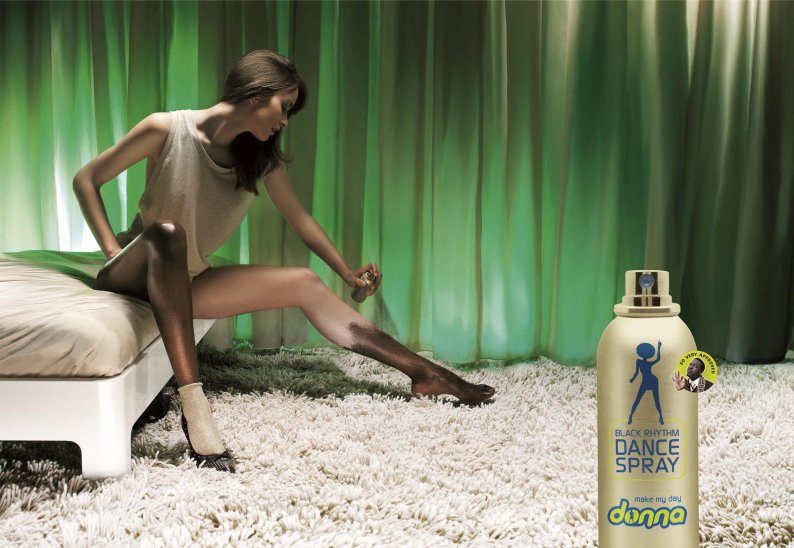
So, not only does this feature a semi-scantily glad woman getting ready for a night out, but it's also capitalizing on popular racial stereotypes.
I found this puzzling print ad on Ads of the World, and initially had a tough time trying to figure out what it advertised. Obviously, there's no real spray for this (try dance lessons), so what's it all about?
Radio Donna. It's some sort of Belgian radio station, and I guess the ad ties in with the hip urban lifestyle they're promoting with their events and music.
The imagery is creative, I'll give them that, and on its face, the ad is original, catches your eye, etc. Still, this objectifies black women; it dehumanizes them in a way. We don't need their faces, their bodies; their identities-- just their groovy legs.
Wednesday, September 06, 2006
TV's Aryan Sisterhood?

As promised, I remembered to find some more info about the glut of blonde women newscasters. Slate had a terrific article and slideshow (written/compiled by Jack Shafer) on this phenomena back in Feb '06, but I think with the ascension of Katie Couric to CBS, this trend is far from withered. Check it out, and then check out TVHeads.com, a website he cites.
The double standard I pointed out (men can go gracefully grey, like silverback gorillas, and maintain power and wisdom--- nay, gather even more prestige with age, while women must stay forever young) is hardly limited to the nightly news. Take a look within our society. How many middle-aged women do you know dye their hair? How many guys?
Besides all of that, certain media outlets give their anchors/stars/newcasters "photoshop diets," making the women look even more youthful, vibrant and healthy. Here's a link to the now famous Katie Couric photos. The same thing happened a couple of days ago with Rosie O'Donnell's press photos for The View.
Unrealistic expectations and body images are being pushed upon the female gender, and while some progress has been made, I think that in certain instances, it's become even more insidious. People know it's sexist to shill beer with babes in bikinis, but fewer people realize that the equivilant is being done to the nightly news.
Some societies look upon older women as leaders and matriarchs. Clearly, that isn't the case with Western culture. Women newscasters (as well as the rest of us women) have to be able to let go of their personal Dorian Grays.
Subscribe to:
Posts (Atom)

